Skip to content
KDSHarwarePoweredByPOE

Power over Ethernet (PoE) for Kitchen Display Systems

Everything You Need to Know About PoE in Your Kitchen and Restaurant.

Power over Ethernet, or PoE, is one of the latest buzzwords in hospitality hardware. And no, we're not talking about Winnie-the-Pooh.

PoE is a technology that has been around for many years. It is widely used to power low-energy network devices such as wireless access points, IP cameras, and VoIP phones. Instead of connecting a device to both a power outlet and a network connection, PoE allows both power and data to travel through a single Ethernet cable.

That sounds ideal, doesn't it? No bulky power adapters, fewer cables, and a much cleaner installation.

So why doesn't every Kitchen Display System support PoE? The answer is simple. A KDS display is considerably more demanding than a security camera. While PoE can be an excellent solution, it only works reliably when the underlying network infrastructure is designed for it.

In this article, we'll explain exactly what you need to build a reliable PoE-powered Kitchen Display System.

Before deciding if you want to use PoE for your business, it's worth understanding what a Kitchen Display System actually is and how it fits into a modern restaurant workflow. If you're new to KDS technology, start with our guide: The ultimate guide to Kitchen Display Systems for Modern Hospitality.

Understanding the different PoE standards

One common misconception is that there is only one type of PoE. In reality, several standards exist, each capable of delivering a different amount of power. Choosing the correct infrastructure starts with understanding how much power your KDS hardware requires.

POE TYPE WATTAGE
POE 15.4
POE+ 30
POE++, type 3 65
POE++, type 4 90


As you can see, the available power ranges from just 15 watts to as much as 90 watts. The higher the power requirement, the more important the quality of your network infrastructure becomes.

The two most important components are your Ethernet cabling and your PoE switch.

Choosing the right KDS hardware

Your Kitchen Display System determines the minimum PoE standard your infrastructure must support.

 Before purchasing switches or cabling, always verify the PoE requirements of the display you intend to use. Installing infrastructure that cannot deliver enough power will prevent the devices from operating reliably. Not all KDS displays are built the same, so it's worth understanding the hardware differences before making a purchasing decision. Our KDS Hardware 101 guide explains the components, specifications, and features that matter most. 

Choosing the right Ethernet cable

Reliable Ethernet cabling has always been important for stable network communication. While Wi-Fi is suitable for many applications, wired networking remains the preferred choice for mission-critical hospitality systems such as Kitchen Display Systems.

Once PoE enters the equation, cable quality becomes even more important. The more power you transmit, the more attention you should pay to the cable specifications.

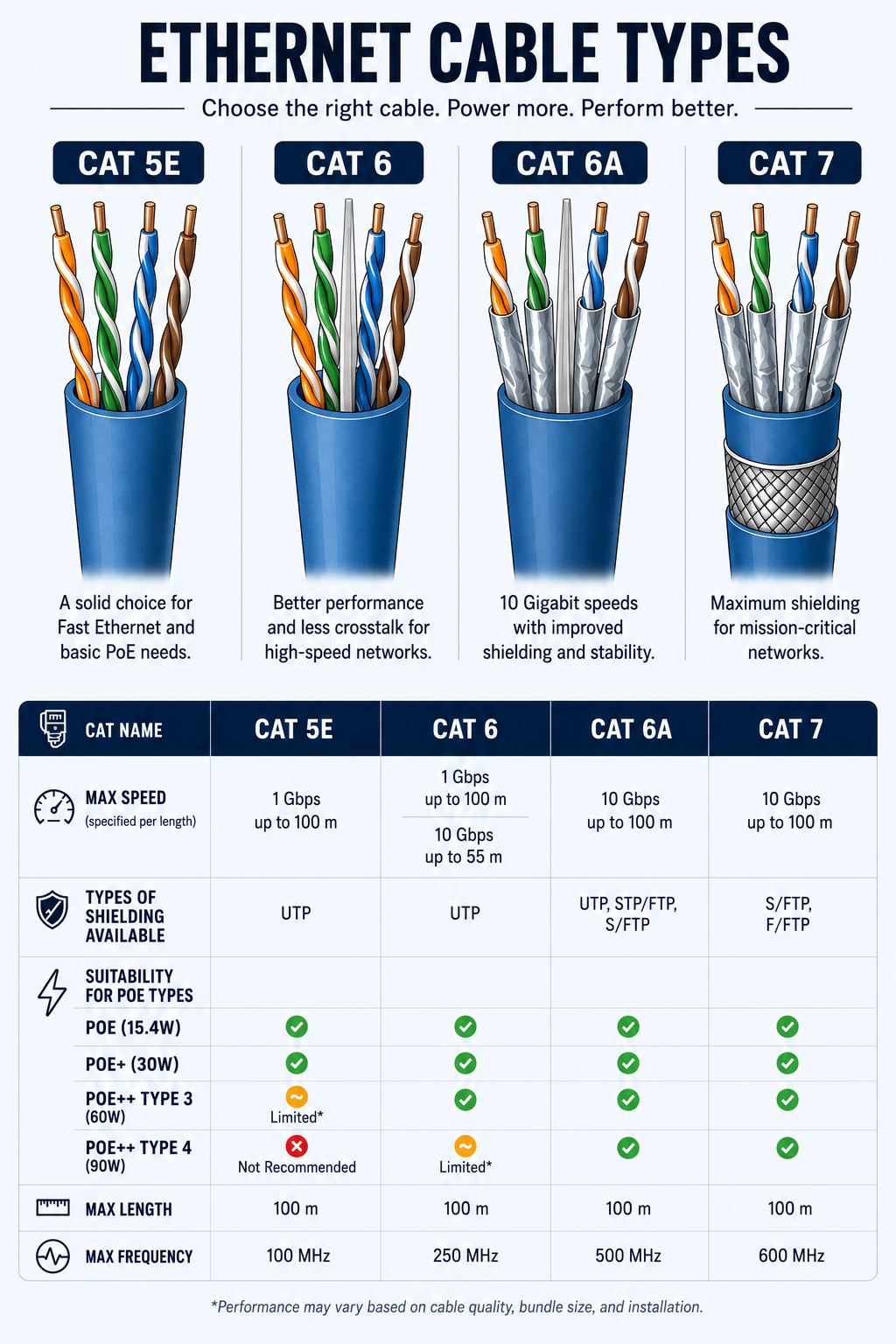
Refer to our infographic for an overview of the different Ethernet cable categories.

Ethernat cablles

**Please note: The illustrations are intended for educational purposes and do not necessarily represent the exact physical construction of every cable type. 

One conclusion stands out immediately: PoE++ installations should use at least CAT 6 cabling.

Our recommendation is to install CAT 6A whenever possible. Although CAT 6A is more expensive, labour is usually the largest cost of any network installation. Installing higher-quality cabling today helps future-proof your infrastructure and can prevent expensive rewiring in the years ahead.

What makes a good Ethernet cable?

When selecting Ethernet cables for PoE, there are several characteristics worth paying attention to.

Use solid copper conductors
Choose cables with an all-copper core, often labelled as OFC (Oxygen-Free Copper). This is by far the most important characteristic of a quality Ethernet cable and has a significant impact on both performance and heat generation.

Avoid CCA cables
Never use Copper-Clad Aluminium (CCA) cables for PoE installations. Because aluminium has significantly higher electrical resistance than copper, these cables generate more heat under load. In high-power PoE installations, this can reduce performance and may even create a safety risk.

Choose the correct wire gauge
Ethernet cables are rated using AWG (American Wire Gauge). The lower the AWG number, the thicker the conductor. Thicker conductors offer lower electrical resistance, which means less voltage drop and less heat generation.

For PoE++ installations, 23 AWG is generally recommended, particularly when multiple cables are bundled together. Proper cable sizing becomes increasingly important as power levels approach 60 to 90 watts.

Selecting the right PoE switch or injector

Once your cabling is in place, the network switch becomes responsible for supplying power to your Kitchen Display Systems.

Many manufacturers, including Cisco, Netgear, HPE Aruba, and Fortinet, offer switches with
integrated PoE support. However, not every PoE switch supports every PoE standard.

Always verify that the switch supports the same PoE standard required by your KDS hardware. For example, a display requiring PoE++ Type 4 cannot operate from a switch that only provides PoE+.

You should also consider the switch's total power budget.

Suppose your restaurant has 15 Kitchen Display Systems that each require approximately 60 watts. Your switch would need to supply roughly 900 watts in total. Not every PoE switch can deliver that much power across all ports simultaneously.


When is a PoE injector useful?

High-capacity PoE switches can become expensive, especially when powering many devices.

Fortunately, there is another option.

A PoE injector adds power to a single Ethernet connection without requiring you to replace your existing switch.

Injectors are ideal when:

  • You only need one or two additional PoE ports.
  • A device is located too far from your existing PoE switch.
  • Upgrading the entire switch would be unnecessarily expensive.

They provide a simple and cost-effective way to power additional Kitchen Display Systems, printers, or other PoE-compatible devices.


Conclusion

Power over Ethernet can be an excellent solution for modern Kitchen Display Systems. A single cable for both power and data creates a cleaner installation and can significantly reduce installation costs, especially when retrofitting an existing kitchen.

However, PoE is only as reliable as the infrastructure behind it.

Choosing the correct Ethernet cables, selecting switches with sufficient power capacity, and understanding the PoE requirements of your KDS hardware are all essential for building a stable and future-proof installation.

When designed properly, a PoE-powered Kitchen Display System combines simplicity, reliability, and flexibility, making it an attractive choice for many hospitality environments.


Redefine what your KDS can do.

See how Annoncer brings structure and control to your kitchen.