

Your restaurant is collecting more data than you think. Are you actually using it?
Every restaurant generates a significant amount of data during a single service. Reservations tell you who is coming, your POS records what guests order and spend, and kitchen systems capture what is being prepared and how the service progresses.
Before the first guest arrives, you may already know how many covers to expect, which guests have allergies or dietary requirements, where larger parties are seated and when the busiest part of the evening is likely to begin. Once service starts, another layer of information is added.
Orders arrive, courses move through the kitchen, tables progress at different speeds and preparation times change throughout the evening. By the end of the night, all of those individual moments form a detailed picture of how the service actually went.
Yet much of that information is still used only in the moment, stored across different systems or simply forgotten once the last table leaves.
The question is no longer whether restaurants have enough data. It is whether they are turning that data into something useful.
Before service: use what you already know.
A well prepared service starts long before the first order reaches the kitchen. Reservation data, for example, can provide both front of house and kitchen teams with useful context about the evening ahead.
Imagine an upcoming service with 85 covers, several larger parties, returning guests and six different dietary requirements. Having that information available allows the team to prepare accordingly. However, its value quickly decreases when it remains inside the reservation system.
An allergy that still needs to be copied, written down or verbally communicated to the kitchen creates another manual step. The same applies to guest preferences, special occasions and other information that could influence the service.
When systems can exchange relevant information, preparation becomes less dependent on someone remembering to check and communicate every detail.
Useful information before service could include:
- Expected covers and arrival times
- Allergies and dietary requirements
- Returning guests and relevant preferences
- Large parties or special arrangements
- Expected peak moments during the service
The objective isn't to give teams more information to process. It is to make sure the information they need is available where they need it.
During service: the plan meets reality.
Every restaurant starts the evening with a plan, but service rarely follows that plan exactly. Guests arrive early or late, one table wants to slow down while another is ready for the next course, and several large orders can reach the kitchen within minutes of each other.
At that point, real time operational information becomes much more valuable than the original plan.
Front of house needs to understand what is happening in the kitchen, while the kitchen benefits from knowing what is happening in the restaurant. Without that visibility, teams often fall back on verbal updates.
How long for table 12?
Can we send the next course?
Is the main course ready?
One question isn't a problem. Dozens of those questions during a busy service create interruptions, additional communication and more opportunities for information to be missed.
When teams share the same operational information, they can make decisions without constantly asking each other for updates. At the same time, the restaurant starts building a much clearer record of what actually happened during service.
That includes information such as preparation times, time between courses, delays and periods where particular parts of the operation were under pressure.
Revenue tells you the result, not the whole story.
After service, revenue is understandably one of the first numbers restaurants look at. It tells you something important about the commercial result of the evening, but very little about how that result was achieved.
Consider two Saturday evenings with similar covers and exactly the same revenue.
During the first service, courses move smoothly, the kitchen stays in control and front of house has time to focus on guests. During the second, the kitchen spends most of the evening catching up, servers repeatedly ask for updates and several tables wait longer than intended.
Financially, those evenings may look almost identical.
Operationally, they are completely different.
This is where preparation times, course timings and other service data provide additional context. They allow restaurants to look beyond the final sales figure and understand how efficiently the operation performed.
Revenue shows what you achieved. Operational data can help explain how you achieved it.
Patterns are more valuable than individual moments.
A slow dish on one evening doesn't necessarily require action. Neither does one table waiting longer than expected. Hospitality involves people, and every service is different.
Repeated patterns are much more useful.
You might discover that a particular course consistently takes longer during peak hours. Perhaps delays start appearing once the restaurant reaches a certain number of covers. One kitchen station may become a bottleneck when several specific dishes are ordered at the same time.
Or the issue may not be in the kitchen at all. Front of house might regularly spend time requesting information that already exists somewhere else in the operation.
Looking at operational data over time can help answer questions such as:
- At what point during service do delays usually begin?
- Which courses or dishes regularly require more preparation time?
- Are certain stations more affected during peak periods?
- How much time typically passes between courses?
- Which information does front of house repeatedly need from the kitchen?
- Are there differences between quieter services and fully booked evenings?
Individual moments tell you what happened once. Patterns help you understand how your operation behaves.
Connect the information instead of collecting more.
Making better use of data doesn't necessarily mean collecting more of it. For many restaurants, the information already exists.
The challenge is that it lives in different places.
The reservation system knows who is coming and may already contain relevant guest information. The POS knows what has been ordered. The kitchen knows what is being prepared and how far each table has progressed. Front of house knows what is happening at the table.
When these systems operate independently, people often become the connection between them. Information is checked, repeated, entered again or communicated verbally.
Integrations can remove part of that dependency.
This doesn't mean every restaurant needs one large platform that handles every process. Specialised systems can continue doing what they do best, while exchanging the information that other parts of the operation need.
That is the thinking behind Connected Hospitality Operations: connecting the different parts of the restaurant without taking away the freedom to choose the technology that fits the operation.
A dashboard doesn't improve your restaurant. Using the insights does.
Having more reports isn't automatically better. Neither is having a dashboard filled with dozens of metrics. The value starts when reporting helps you understand what is happening in your operation and gives you something you can act on.
This is where reporting and analysis becomes interesting. Instead of looking at individual moments during a service, you can use historical operational data to identify trends and compare performance over time.
For example, reporting can help you analyse:
- Preparation times per dish, course or kitchen station
- Differences between busy and quieter services
- Recurring delays and bottlenecks
- Course timing throughout the evening
- Operational performance over a longer period
If preparation times consistently increase during a particular part of the evening, you can investigate what changes at that moment. If one course regularly affects the timing of the rest of the menu, you can look at the process behind it. And if the same bottleneck appears across multiple services, you have a much stronger indication that there is something worth investigating.
Don't start with the data. Start with what you want to understand.
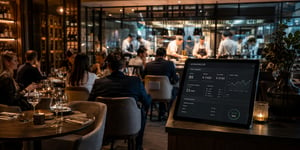
A useful dashboard shouldn't simply show you more numbers. It should make it easier to recognise patterns, ask better questions and make informed operational decisions.
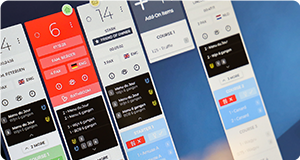
That is exactly what Annoncer Reporting & Analysis is designed for: turning the operational data generated during service into information you can use afterwards.
Turn service data into operational insight.
Restaurant technology shouldn't create another layer of information for teams to manage. It should help teams use the information that is already being generated.
Before service, data can help you prepare for the guests and workload ahead. During service, it provides visibility across front of house and kitchen. After service, reporting and analysis turns that operational data into insights you can use to understand trends, identify bottlenecks and improve future services.
Your restaurant is already generating this information every day.
The opportunity is to connect it, analyse it and use what you learn to make the next service better.